Daily living · House & Home

Just 5 Tips on Minimizing Food Waste

One thing I feel like a lot of us are trying to do with increasing food prices is cut down on waste. Over the years, I’ve found better ways of cutting down on food that gets tossed by getting more organized and putting new systems/habits in place.

Don’t buy in bulk

Let me preface this one by saying that we’ve never been in a living situation that had extra food storage space. We’ve never had a basement, and we’ve never had an extra fridge or a deep freezer. We’ve actually only had a pantry in two of our five homes we’ve lived in since being married. Our current pantry is not that big, and my “overflow” area is just a small bin on the floor of the pantry. There’s really not a lot of room in it, so I try to limit it to frequently used condiments, favorite snacks, and the cereal we eat. I keep one extra of items and that’s it!

Use containers to organize

I’ve found that the more organized my pantry and fridge are, the easier it is for me to keep track of what I have. For me, that means containers to corral things. I am a little self-conscious about my personal organizing because it’s not pretty. But I also feel like we all see so many photos and videos of gorgeous organized homes, and that’s just not how most of us live in our homes! So I’ll be sharing some photos of my home that have not been tidied or cleaned up… it’s just how it looks on a normal day. In my fridge, I have a bin on the top shelf just for butter so I can clearly see if I’m running low on either type. As you can see, I also store guacamole in that bin… no explanation for that. I have a bin on the next shelf of my fridge that’s for all opened meat & cheese products. Any extra (and unopened) meat and cheese go in the bin below that. That way I can mostly avoid several open packages of the same item.
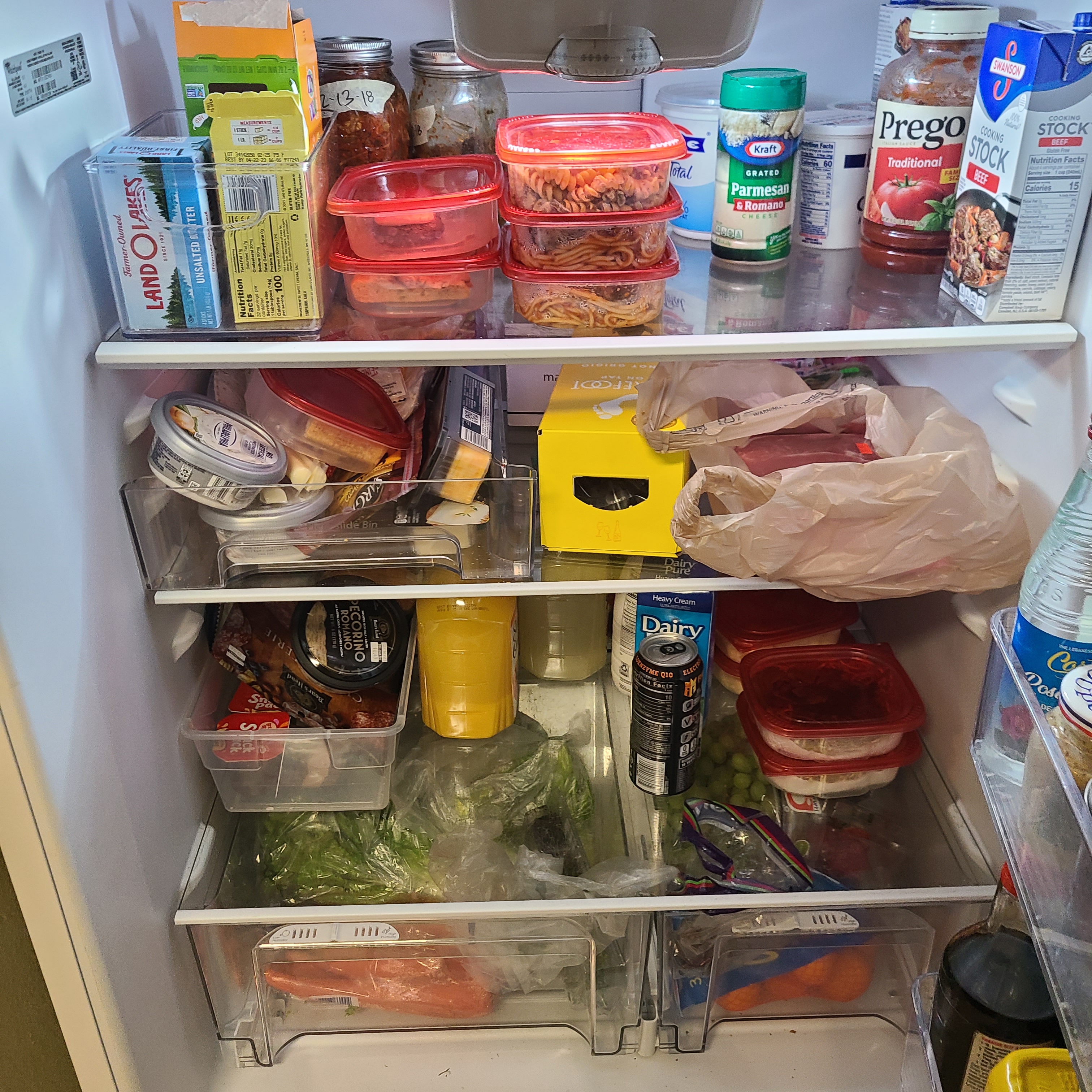
I do the same thing in my pantry. It’s not a huge pantry, so keeping like items together helps keep things organized. I have a bin with snacks (with clips right on the side wall for chip bags) at the kids’ level, I have another with baking items (things like baking soda, bags of chocolate chips, various extracts, packets of yeast, etc), and Andrew has his own bin of all the random Asian ingredients he acquires for different dishes he wants to make. I repurposed some wine boxes to organize oils and vinegars that don’t fit in the spice cabinet as well as one for nuts and seeds. I keep all of our pasta and pasta stuff (sauces, Parmesan cheese) in an old Amazon box. I’d love to have a beautiful pantry with matching bins and baskets, but I also like instant results that don’t cost me a thing! So a lot of my pantry is organized with empty cardboard boxes that I just write on with a Sharpie.
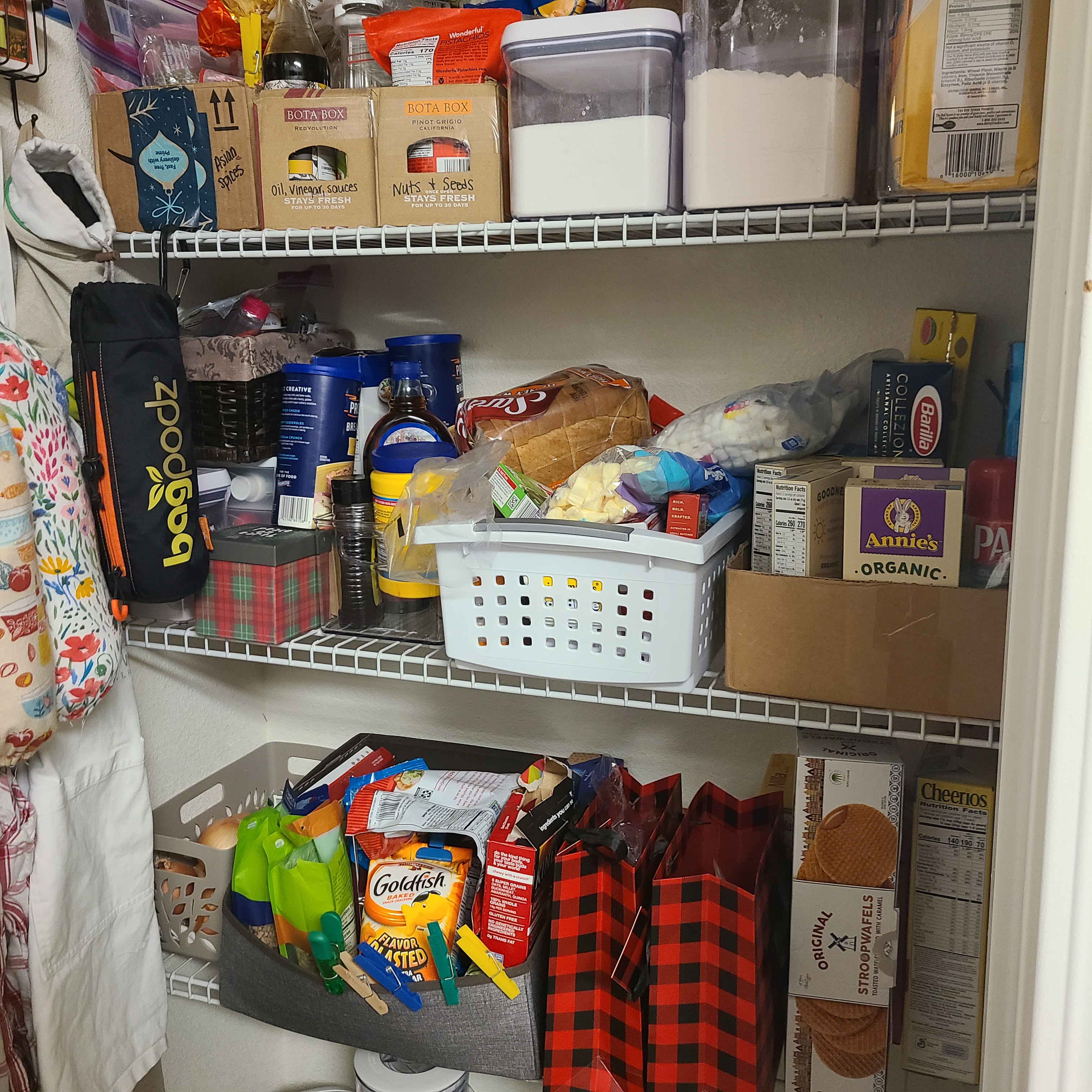
Like I said… not super fancy or meticulously organized, but we know where things are. For the most part.

Have a system for leftovers

I remember Andrew asking me every day “which one of these containers am I supposed to eat?” and it drove me crazy. I eventually started telling him “it’s always the top container furthest to the left!” When he asked me how I knew that, I told him I had a system. The newest leftovers were always on the bottom and furthest to the right on the top shelf. “Seriously?” he asked. “You move the containers around every night?!” I admitted that yes, I kept them organized this way to make it easy for him (and me) to go right in order of oldest to newest.
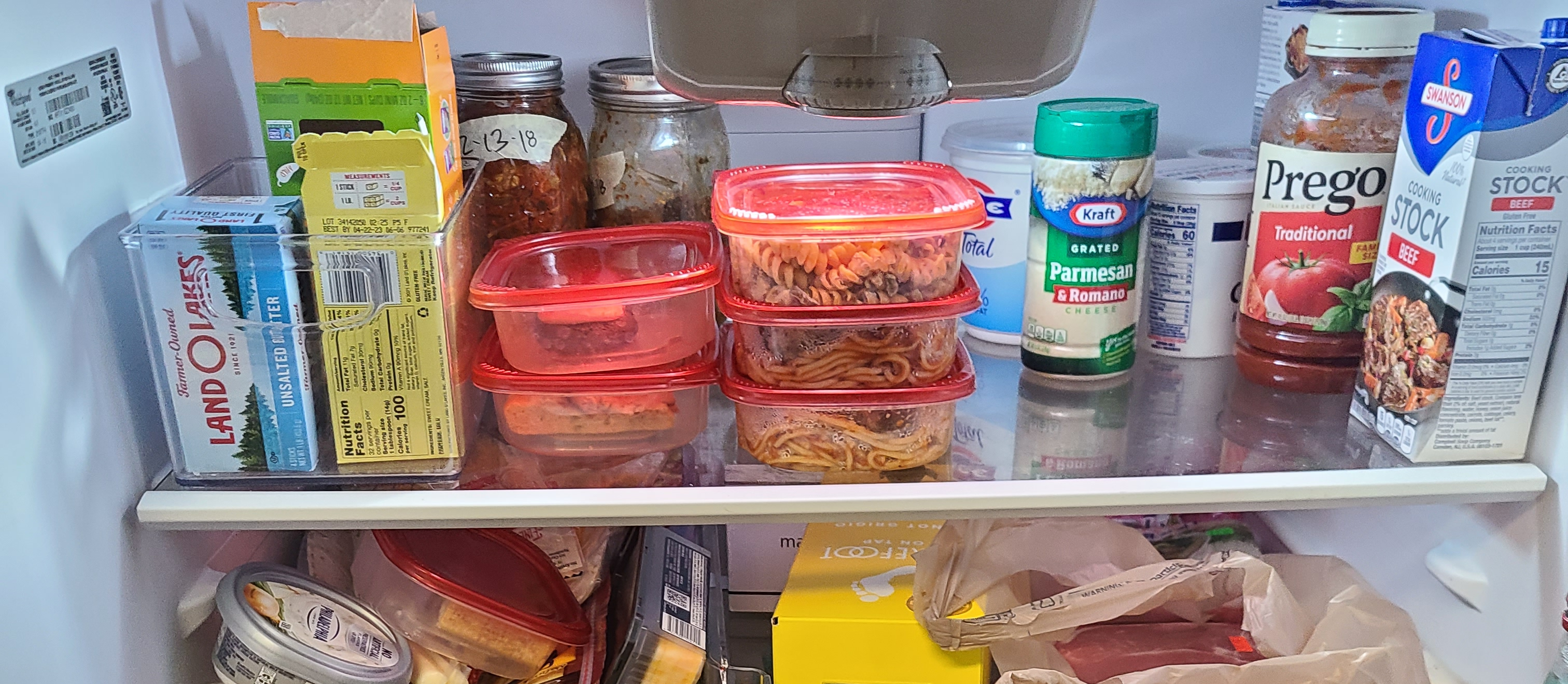
I also only keep leftovers for 4 days; if it’s not eaten on the 4th day after I made it, it goes in the trash. It makes it easy to not lose food and end up with the dreaded gray or white fuzzy mold containers, and it’s a lot more likely that all the leftovers will get eaten.

Plan to do a big purge

Twice a year (hopefully) I do a big purge of the freezer, refrigerator, and pantry. I incorporate it into my spring and fall cleaning where the whole fridge/freezer gets cleaned inside and out, and I also empty the pantry to clean it. This is when I check all the expiration dates, toss things that haven’t been touched in the last 6 months, and make sure everything is organized again. I feel like purging fairly often (once or twice a year) helps you remember what you have so you’re more likely to actually use it.

Stick to your menu

I can’t emphasize this one enough: if you want to minimize food waste, you have to stick to your menu! If you’re frequently deciding you don’t want what’s on your menu, your meat will spoil, your fresh veggies and fruit will get moldy, and you’ll just end up trashing a lot of food. If I ever have to change things up at the last minute, I try to make sure the menu just gets bumped back a day or I freeze what I can.

I hope some of these tips have been helpful for trimming your grocery bill and tossing less food! Do you have any systems that work well for you?

Daily living

Just Five of my New Year’s Resolutions

I know, I know… I vanished for 3 months. I took a break to focus on Gerrit’s 8th birthday and Halloween, then Andrew had a 5 week TDY plus the hustle and bustle of December and Christmas… I meant to get back into blogging as we rolled into 2023, and then I got hit with a cold bug that took me out for over 2 weeks. Now that I’m finally feeling better, I thought I would get back into blogging with my first resolution:

Blog weekly

Since this definitely didn’t stick last year, I figured I would work on it again this year! While I had thought Wednesdays would be the best day for me to work on blog posts, it has turned out that Wednesdays are often my busiest days that both boys are in school. So now I’m shooting for Mondays — wish me luck!

Make my bed every day

I have never been someone who makes their bed every morning. Andrew actually usually straightens things and makes the bed right before he goes to bed for the night, but the days I remember to make the bed, he tells me how much he likes having it made. So I’m definitely trying to make this a new habit not only for Andrew, but also because I really like how it looks too!

Do a load of laundry every day

This one is kind of a cheat resolution… I actually started trying to do this before the new year began. It’s been a really good habit for me though. I usually start a load in the washer when I’m starting dinner, then I switch it to the dryer after the kids go to bed. Sometimes I even fold that load of laundry before I go to bed while watching TV! Then it’s ready to go upstairs and be put away right away the next morning. One thing that held me up in the past was not bringing the dirty laundry downstairs daily. Andrew and I would just let it pile up in the basket until one of us grudgingly brought it down to the laundry room. But now, if Andrew doesn’t beat me to it, I bring it down after getting the kids to bed. The other thing that I would let get in the way of being on top of laundry was waiting until a basket was full in the laundry room. Yes, I still sort my laundry… it’s a habit I can’t seem to let go of. I mostly like to sort because I like to wash socks, underwear, and towels/washcloths on a quick cold cycle followed by a hot cycle, but I wash all of our clothes in cold water. Anyways… now that I’m washing a load daily, I just wash whatever basket is the most full, even if it’s not all the way full. Because honestly, a smaller load is going to wash and dry better than an overfilled load anyway.

Figure out a deep clean schedule

I know I’ve said that I’d prefer to do a hardcore 2-week deep clean of the house in the spring and fall than tackle it slowly all year round… but I think I’m changing my mind. I balked at the thought of fall cleaning this past September, and I think I only ended up getting a few things done in the kitchen. I totally lost steam, got overwhelmed, and ignored my to-do lists. So this year I’m going to try it the other way: tackle one small thing each day focusing on the downstairs in the spring and fall and the upstairs in the summer and winter. This will include decluttering, deep-cleaning, and any projects I want to get done in the house. Let me know if you’re interested in doing this with me, because I plan to start in March!

Start walking daily

This may have been one of my resolutions last year, or it was something I told myself I would do on the days both boys were in school this past fall. Either way… it hasn’t happened. Ideally, this is something I will do right after school drop off in the morning. So for now, I’m just going to shoot for 3 days a week. And I’ve realized that the reasons I don’t currently walk in the morning? 1. I’m self-conscious about walking by myself, and 2. I think it’s boring. So I think I’m going to start listening to a book or podcast while I walk to take care of both issues!

Do you come up with New Year’s resolutions for yourself? Do you usually find that you’re successful with them or not so much? I think all of my research into productivity and motivation has given me a lot of great ideas for being more successful with creating new habits, but we’ll see if 2023 is really my year!

Daily living · House & Home

Just 5 Tips to Creating & Sticking to a Weekly Menu

I wasn’t sure what I wanted to title this post, because there’s a lot I want to cover in terms of food, grocery shopping, and cooking. But for now, I’m going to focus on using a menu regularly. Creating and sticking to a menu takes a lot of guesswork out of evenings, cuts down on food waste, and makes grocery shopping a breeze.

Before Andrew and I got married, I honestly don’t remember how I fed myself. I know I didn’t do much cooking or planning, and I think there were a lot of frozen pizzas and scrounging up pasta dishes in that phase of life. When we first moved to England, we were stuck in a hotel room for a month with a tiny fridge and a microwave. We ate out a lot! But once we got settled into our house, it was on me to make up for the splurging we did eating out so often and keep a tight food budget. For someone who had done minimal cooking and zero food planning, I really didn’t know what the heck I was supposed to do. I remember searching for cheap meals and budget-friendly dinners, then just doing my best to figure out new recipes. Eventually I started writing all my meal plans on a print-out calendar page in pencil. I would try to figure out a whole month’s worth of meals at a time and stick it on the fridge. Doing it in pencil meant I could move things around if work schedules changed or events popped up.

My newlywed menu-writing worked out pretty well for quite awhile. I feel like it kind of fell apart when we added Gerrit to our family, because I was trying so hard to stick to my old normal instead of accepting that my new normal was going to require some major adjusting. Those first few months of newborn life are a blur in my memory, and I will forever be grateful for the meal trains that were set up for us. Even after the food deliveries stopped, I can’t remember what I attempted to cook for awhile! Once Gerrit was moving out of the newborn stage, we were packing up to move back to the States, and that PCS phase meant a lot of not cooking again. Even after we got settled in North Carolina, I can’t remember what I cooked or how I got things done. I think I dealt with post-partum depression & anxiety for quite awhile plus considerable sleep deprivation, and I have to look at pictures and videos to even try to recall that time.

Let’s fast-forward to 2020. Right as the pandemic began, Andrew deployed. As everything closed down and so many of us felt a loss of control in our lives, I decided to buy a planner. I hadn’t used one regularly since college, but in a time when I needed something to give me structure in my days and weeks, I relied heavily on having things written down. We really didn’t have actual social plans, but I used my planner to keep track of household chores, our daily menu, and the progress of the pandemic. I discovered that having my menu written down in a book meant I could easily look back at the last month of meals and more or less repeat it if I wanted to. So here comes tip 1:

Write down meals you enjoy and will actually make

For me, this is my previous months’ written down meals. The ones we enjoy and I make regularly pop up every month, and if I try a new meal and it’s a winner, I will make a point of repeating it. But if this is your first time trying this whole menu-writing thing, just get a sheet of paper and jot down the first 10 meals or so you can think of that everybody will generally eat and you don’t hate making. Do you have something you eat every week? This could be something like Taco Tuesdays or Friday Pizza Nights. If you do those weekly, you already have 2 meals taken care of! In our house, every Monday is Pizza & Salad Night, and every Thursday is Spaghetti & Meatball Night.

Write your menu

I mentioned before that I used to pencil out a whole month of meals at a time, but once I had kids, I found I just didn’t have that kind of planning time on my hands anymore. Now I just do a week at a time, and that’s a lot easier to work around with Andrew’s flying schedule. So take your list of recipes, and if you have a couple of weekly regular meals, go ahead and plug those into whatever you choose to write your menu on: calendar, dry-erase board, an app on your phone. As you go to fill in the remaining days with meals from your list, consider what your days usually look like or which days on your calendar are fuller. Do you or your spouse work late one night? Do you have kids that have to go to practice or lessons some evenings? Do you have an afternoon appointment one day? Take those things into consideration when choosing your meals for each night.

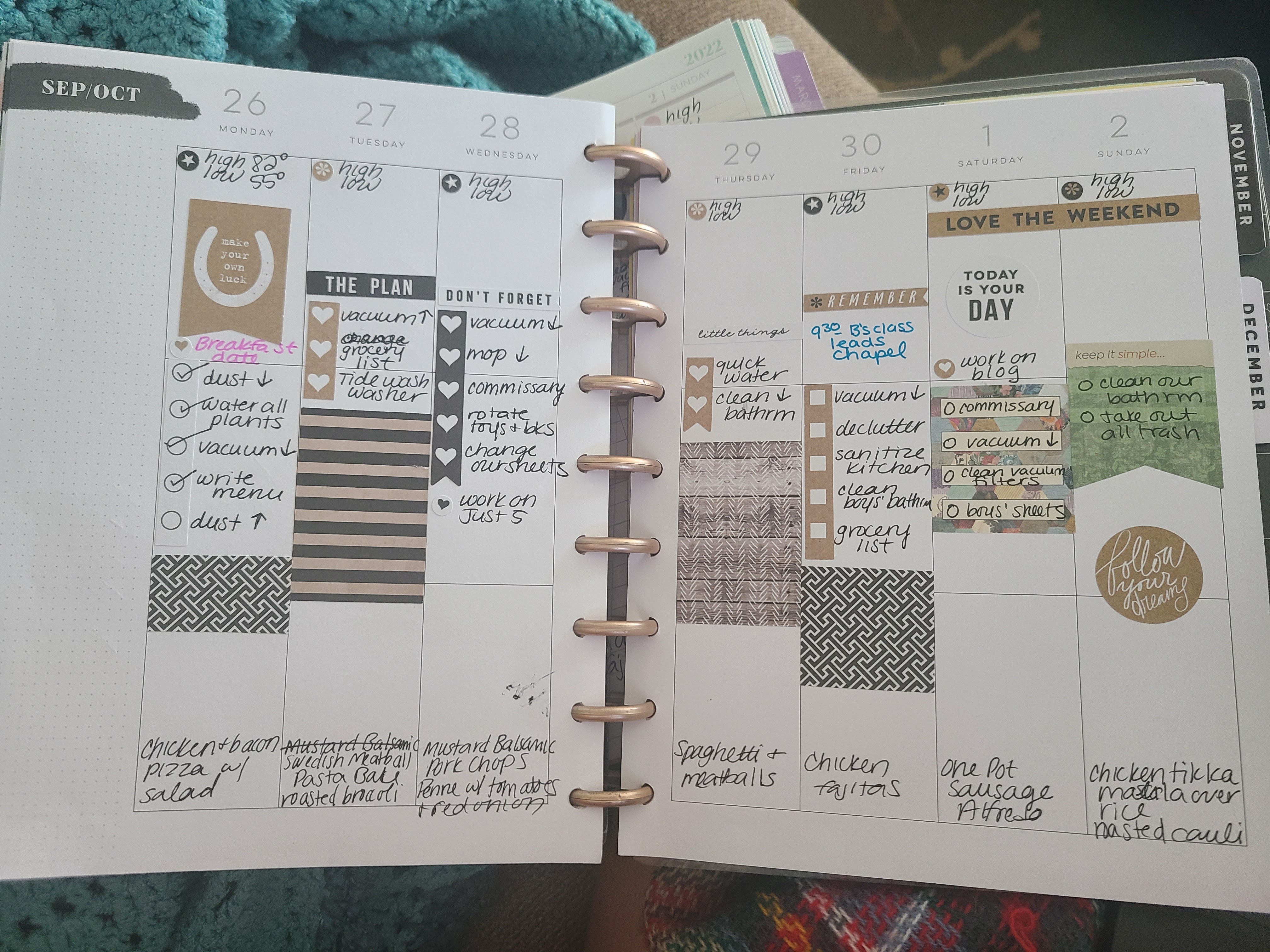
I write my menu at the bottom of each daily column

It’s okay to put easy meals on those days (pick up take-out, frozen pizza, etc.), and if you’re trying to stick to homemade meals, think about your favorite slow cooker meals or pick up some refrigerated pasta and find a quick sauce you can make to go with it. Just make sure it’s something you can stick with, because now it’s time to…

Write your grocery list

Okay, I’m about to reveal a bit of my crazy now… I like to color-code my grocery shopping list and break down my list by aisle. While you definitely do not need to color-code your grocery list, I DO recommend writing down your groceries by category or aisle as a way to keep it organized so you can get in and out as quickly as you can: produce, pantry items, meat, dairy & eggs, cleaning supplies, frozen section, etc. This can also help you keep track of how much of something you need: maybe you need 1 cup of mozzarella for one recipe and 2 cups for another. Just write down mozzarella and tally the amount you need next to it as you go through each recipe you plan on making. Of course, you can save even more time by setting up a grocery pick-up or delivery instead. I used to always just do a weekly grocery trip, but now I usually do two. Two trips means faster trips (less impulse buying for me) as well as fewer things spoiling before we get to actually use them.

Stick to the plan

For some people, this can be a difficult thing. My husband will tell you that I stick to my menu to a fault. If he wants to cook one night or go out to dinner, I tell him he needs to tell me in advance so it’s on the menu! Even if you don’t feel like cooking what you have on your menu, try to stick to it or flip flop some meals if you need to. Going off plan too much will just result in wasted food and money.

Eat your leftovers

If the meals you chose usually have leftovers, plan on eating them. If no one in your house likes leftovers, plan to alter your recipes to make roughly just what you need for dinner so there’s not too much waste. But that means you shouldn’t even make up containers of leftovers if no one is going to eat them. If you do like leftovers, that should be your plan for lunch at some point during the week.

I have found that writing a menu, using that menu for grocery shopping (and sticking to that list), and following through with my plan has been the best way for us to keep our food bill as low as we can, minimize food waste, and eat relatively healthy.