I wasn’t sure what I wanted to title this post, because there’s a lot I want to cover in terms of food, grocery shopping, and cooking. But for now, I’m going to focus on using a menu regularly. Creating and sticking to a menu takes a lot of guesswork out of evenings, cuts down on food waste, and makes grocery shopping a breeze.
Before Andrew and I got married, I honestly don’t remember how I fed myself. I know I didn’t do much cooking or planning, and I think there were a lot of frozen pizzas and scrounging up pasta dishes in that phase of life. When we first moved to England, we were stuck in a hotel room for a month with a tiny fridge and a microwave. We ate out a lot! But once we got settled into our house, it was on me to make up for the splurging we did eating out so often and keep a tight food budget. For someone who had done minimal cooking and zero food planning, I really didn’t know what the heck I was supposed to do. I remember searching for cheap meals and budget-friendly dinners, then just doing my best to figure out new recipes. Eventually I started writing all my meal plans on a print-out calendar page in pencil. I would try to figure out a whole month’s worth of meals at a time and stick it on the fridge. Doing it in pencil meant I could move things around if work schedules changed or events popped up.
My newlywed menu-writing worked out pretty well for quite awhile. I feel like it kind of fell apart when we added Gerrit to our family, because I was trying so hard to stick to my old normal instead of accepting that my new normal was going to require some major adjusting. Those first few months of newborn life are a blur in my memory, and I will forever be grateful for the meal trains that were set up for us. Even after the food deliveries stopped, I can’t remember what I attempted to cook for awhile! Once Gerrit was moving out of the newborn stage, we were packing up to move back to the States, and that PCS phase meant a lot of not cooking again. Even after we got settled in North Carolina, I can’t remember what I cooked or how I got things done. I think I dealt with post-partum depression & anxiety for quite awhile plus considerable sleep deprivation, and I have to look at pictures and videos to even try to recall that time.
Let’s fast-forward to 2020. Right as the pandemic began, Andrew deployed. As everything closed down and so many of us felt a loss of control in our lives, I decided to buy a planner. I hadn’t used one regularly since college, but in a time when I needed something to give me structure in my days and weeks, I relied heavily on having things written down. We really didn’t have actual social plans, but I used my planner to keep track of household chores, our daily menu, and the progress of the pandemic. I discovered that having my menu written down in a book meant I could easily look back at the last month of meals and more or less repeat it if I wanted to. So here comes tip 1:
Write down meals you enjoy and will actually make
For me, this is my previous months’ written down meals. The ones we enjoy and I make regularly pop up every month, and if I try a new meal and it’s a winner, I will make a point of repeating it. But if this is your first time trying this whole menu-writing thing, just get a sheet of paper and jot down the first 10 meals or so you can think of that everybody will generally eat and you don’t hate making. Do you have something you eat every week? This could be something like Taco Tuesdays or Friday Pizza Nights. If you do those weekly, you already have 2 meals taken care of! In our house, every Monday is Pizza & Salad Night, and every Thursday is Spaghetti & Meatball Night.

Write your menu
I mentioned before that I used to pencil out a whole month of meals at a time, but once I had kids, I found I just didn’t have that kind of planning time on my hands anymore. Now I just do a week at a time, and that’s a lot easier to work around with Andrew’s flying schedule. So take your list of recipes, and if you have a couple of weekly regular meals, go ahead and plug those into whatever you choose to write your menu on: calendar, dry-erase board, an app on your phone. As you go to fill in the remaining days with meals from your list, consider what your days usually look like or which days on your calendar are fuller. Do you or your spouse work late one night? Do you have kids that have to go to practice or lessons some evenings? Do you have an afternoon appointment one day? Take those things into consideration when choosing your meals for each night.
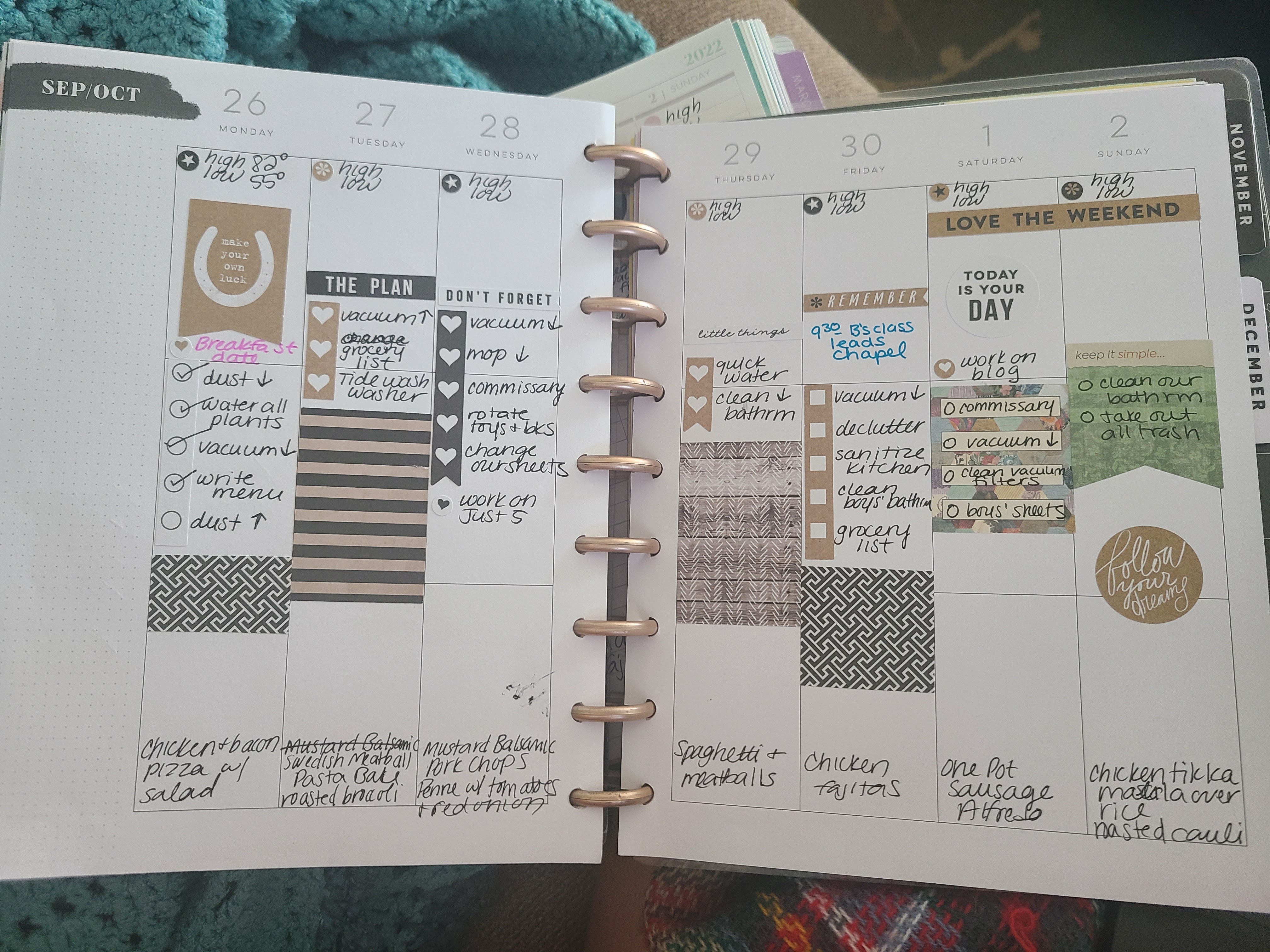
It’s okay to put easy meals on those days (pick up take-out, frozen pizza, etc.), and if you’re trying to stick to homemade meals, think about your favorite slow cooker meals or pick up some refrigerated pasta and find a quick sauce you can make to go with it. Just make sure it’s something you can stick with, because now it’s time to…
Write your grocery list
Okay, I’m about to reveal a bit of my crazy now… I like to color-code my grocery shopping list and break down my list by aisle. While you definitely do not need to color-code your grocery list, I DO recommend writing down your groceries by category or aisle as a way to keep it organized so you can get in and out as quickly as you can: produce, pantry items, meat, dairy & eggs, cleaning supplies, frozen section, etc. This can also help you keep track of how much of something you need: maybe you need 1 cup of mozzarella for one recipe and 2 cups for another. Just write down mozzarella and tally the amount you need next to it as you go through each recipe you plan on making. Of course, you can save even more time by setting up a grocery pick-up or delivery instead. I used to always just do a weekly grocery trip, but now I usually do two. Two trips means faster trips (less impulse buying for me) as well as fewer things spoiling before we get to actually use them.

Stick to the plan
For some people, this can be a difficult thing. My husband will tell you that I stick to my menu to a fault. If he wants to cook one night or go out to dinner, I tell him he needs to tell me in advance so it’s on the menu! Even if you don’t feel like cooking what you have on your menu, try to stick to it or flip flop some meals if you need to. Going off plan too much will just result in wasted food and money.

Eat your leftovers
If the meals you chose usually have leftovers, plan on eating them. If no one in your house likes leftovers, plan to alter your recipes to make roughly just what you need for dinner so there’s not too much waste. But that means you shouldn’t even make up containers of leftovers if no one is going to eat them. If you do like leftovers, that should be your plan for lunch at some point during the week.

I have found that writing a menu, using that menu for grocery shopping (and sticking to that list), and following through with my plan has been the best way for us to keep our food bill as low as we can, minimize food waste, and eat relatively healthy.

 On An Even Kiel