First of all, BLW = Baby-Led Weaning. Basically, all it means is allowing your child to wean (in this case, “wean” simply means adding solid food, not reducing breast milk or formula feedings) at their own pace and feed themselves independently. Here is The Book that really goes through everything for you, as well as the cookbook by the same authors.
I first heard of Baby-Led Weaning when I started breastfeeding. I am a member of a breastfeeding group on Facebook, and I would occasionally see the acronym “BLW” pop up when moms discussed solid foods. As I read more about it and heard others’ opinions, I started getting more and more interested in it. When I mentioned it to the hubby, he was all for it. As a parent, Andrew is definitely a fan of anything natural and instinctual: co-sleeping, baby-wearing, feeding on demand, and now BLW. I obviously find myself leaning in that direction as well!
As I go through this, let me just say that while most of things I write here are backed up by books and organizations such as WHO and AAP, they are also my opinions. I’m not trying to tell anyone that the way they choose to feed their child is “right” or “wrong,” but I AM entitled to my own thoughts on the subject.
There are 2 big points for BLW:
1. Don’t introduce any solid foods until your baby is at least 6 months old. This includes rice cereal (spoon-fed or added to a bottle) and any purees.
2. Offer your child items that they can grasp and feed themselves independently.
Let’s start with the 6 months of age thing. I realize that all of us were probably fed rice cereal and/or purees earlier than 6 months old. But that’s because that’s what doctors recommended back in the ’80s and ’90s. The most current medical opinion is to wait until your baby is at least 6 months old, NOT 4-6 months of age, to begin introducing solids. Here is a link to KellyMom for more information; there’s no need for me to go into detail when she has it all explained for you! A few key points:
- Baby will have more protection from illness
- Baby’s digestive system will be more mature
- Starting solids will be easier
- Baby may have more protection from iron-deficiency anemia
There are “signs of readiness” for solid foods that also match up fairly well with being 6 month old:
- Baby can sit up well without support
- Baby has lost the tongue-thrust reflex (forcing solids out of mouth with tongue)
- Baby is developing a “pincer” grasp
- Baby shows interest in food and chewing
Clearly, all babies develop at their own pace. So some babies may not even be ready for solids at 6 months. Take Gerrit at 6 months for example: he could sit well without support, he had lost the tongue-thrust reflex, and he was interested in food (and chewing on EVERYTHING). His fine motor skills weren’t quite there with the pincer grasp, but it was probably developing. So we started solids at 6 months.
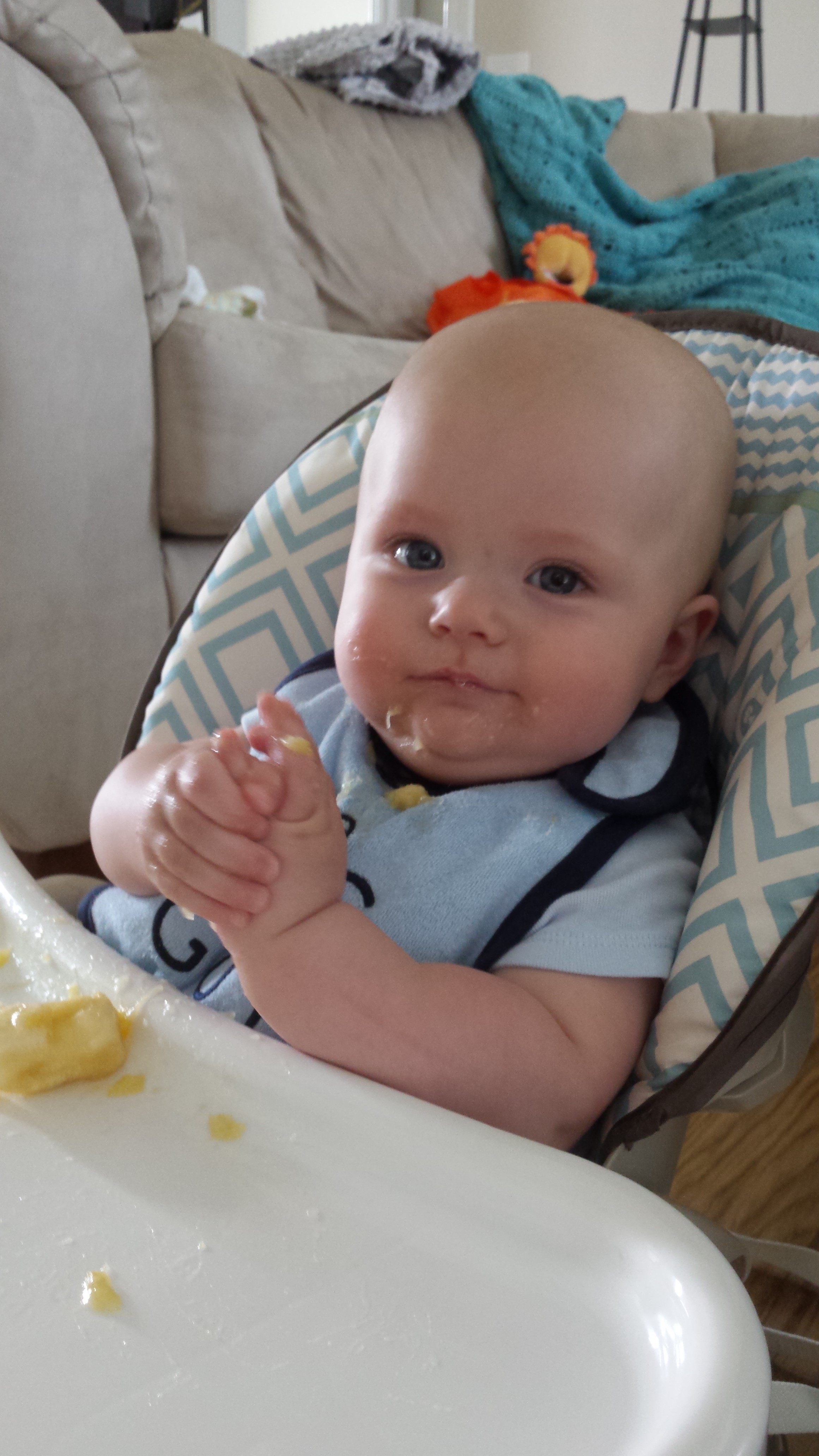
Was he ready? Probably. He was interested in putting the food in his mouth, but he didn’t seem to know that he could ingest it! He certainly enjoyed the experience of squishing and smashing the food, and there was little that he didn’t seem to enjoy (he was not so sure of avocado).
Now we move on to the foods that they can grasp independently. This is pretty much anything in a stick shape. Most 6 month old babies do not have the pincer grasp mastered. So the food you offer them should be something they can hold in their fist, but long enough that it sticks out of the top of their fist. Here is Gerrit gumming a piece of steak:
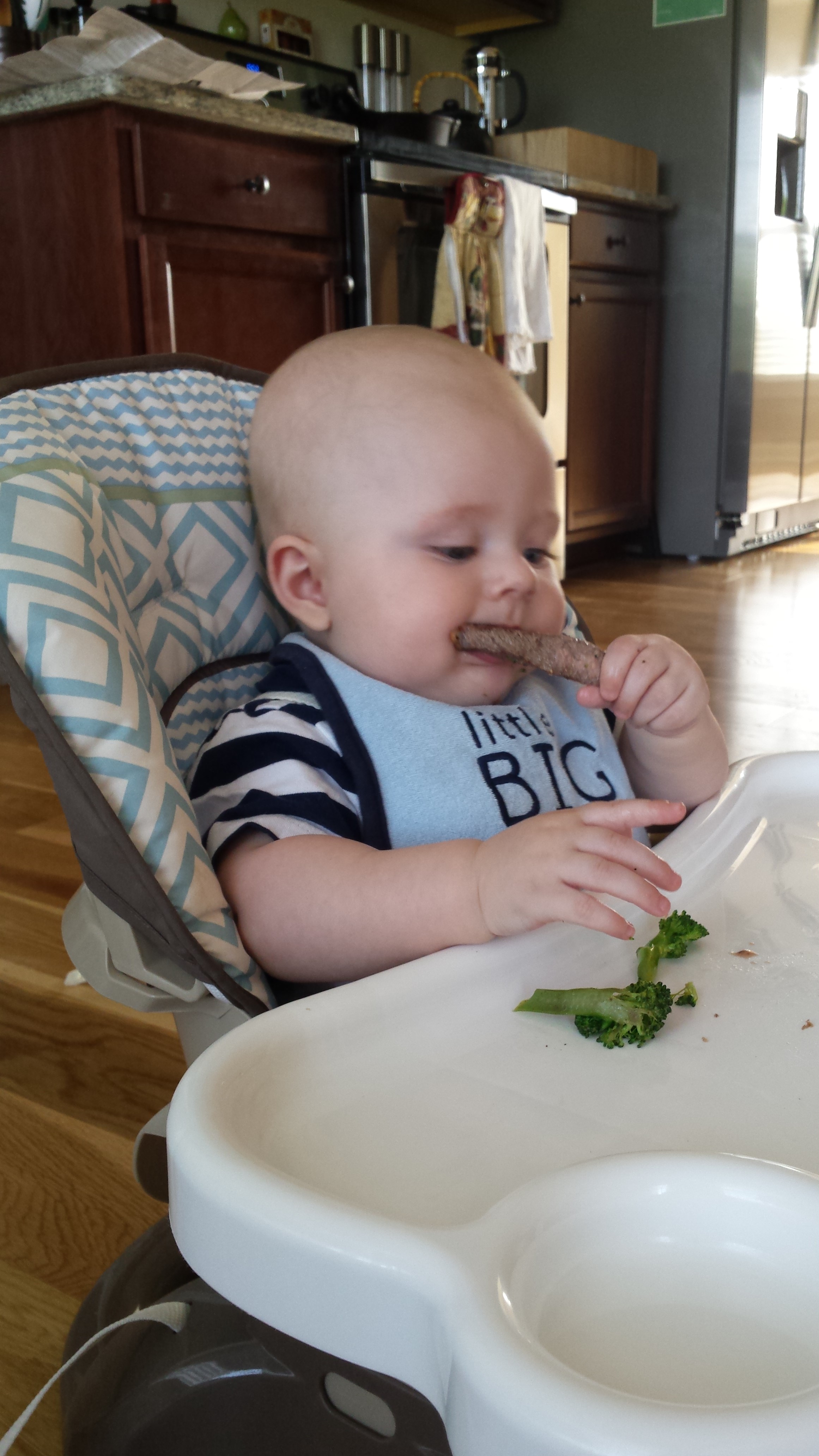
As you can see, he is gripping part of the strip of steak in his fist, but it’s plenty long enough for him to still chew on the end. By the way, he LOVED that steak! He barely touched the broccoli, which he had enjoyed a lot in the past. He didn’t have any teeth at this point, but that didn’t stop him from enjoying the flavors and textures of foods like steak and veggies at an early age.
I think what really sold me on BLW was the list of benefits:
- It’s natural
Your baby can explore food at his/her own pace. Most animals in the wild are not offered purees, after all. They watch their parents eat solid food and begin to imitate the behavior while still nursing from their mother. - Learning about food
Your baby learns about different smells, tastes, and textures of food. It isn’t all pureed into one thing. - Learning to eat safely
Your baby learns that things can’t just be swallowed down! Some foods need to be chewed. Some things are too big and bites need to be taken out of them. It can make babies less likely to choke. - Gaining fine motor skills
What other ways can a baby this age practice the pincer grasp? Anything that is small enough to be picked up with the fingers is probably something your baby can choke on! So introducing solids helps your baby practice using their fingers with items that they can actually chew and swallow. - Gaining confidence
Allowing babies to do things for themselves gives them confidence in their abilities and judgment. Confident babies grow into confident toddlers who aren’t afraid to try new things. - Being part of family mealtimes
With BLW, babies eat what their families eat. Everyone can eat at the same time, without one parent having to spoon-feed the baby. They are able to learn about the social aspect of mealtimes: how different foods are eaten, how to share, how to wait their turn, and how to have a conversation. - Long-term health
Because breastfeeding is reduced very gradually (and at the pace the child chooses), BLW babies are more likely to continue breastfeeding longer. This means they are getting the perfect balance of nutrients and also more protection against illnesses. - It’s easier & cheaper!
As long as what we are eating is healthy, we just give a small amount of it to Gerrit. No buying baby food or pureeing food.
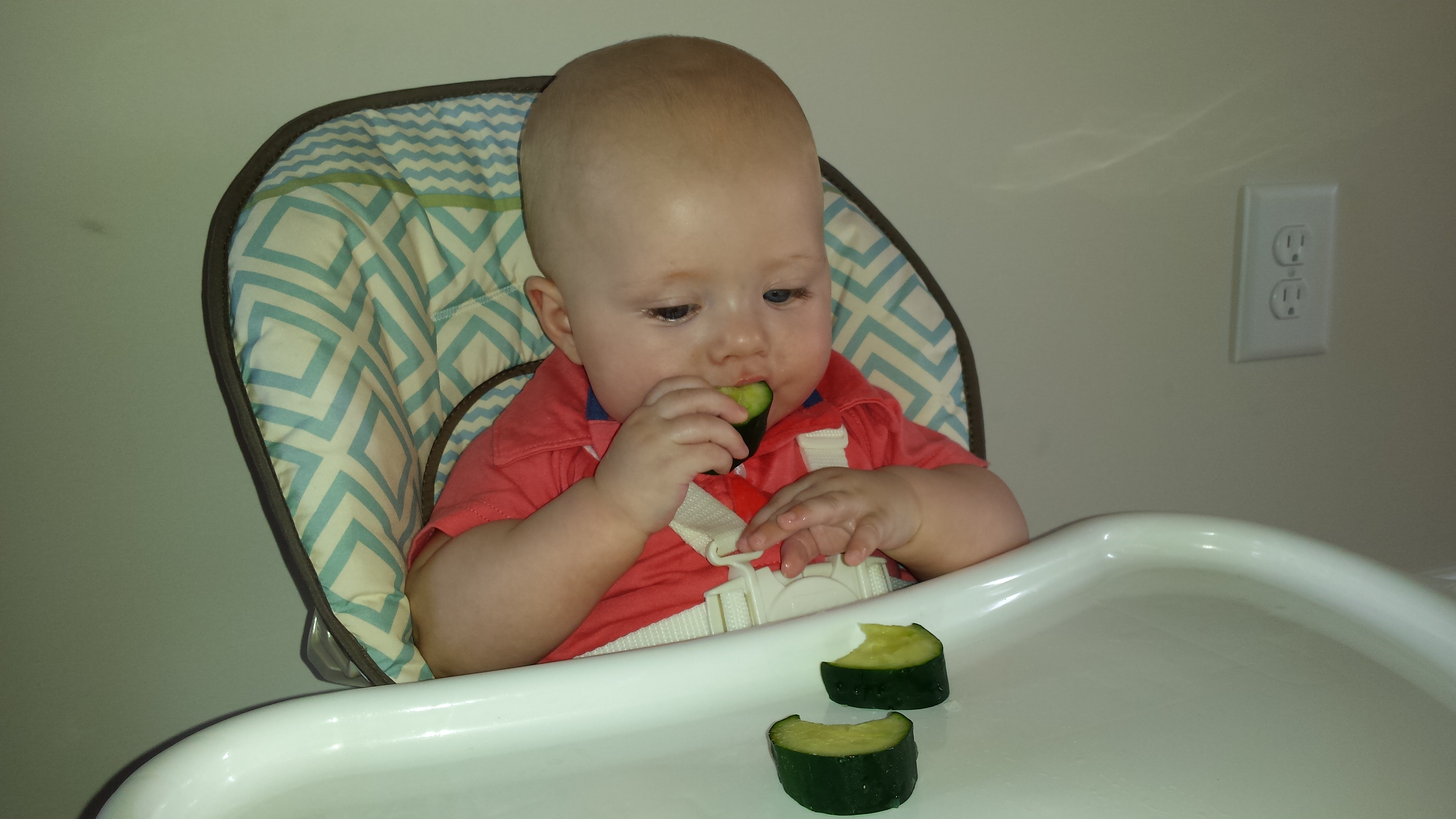
Now for our story with BLW… We had given Gerrit some hard things to gum (apple slices and carrot sticks) a little before he turned 6 months old. He seemed interested and treated it like just another one of his toys he chewed on. As excited as I was to “officially” begin BLW, when Gerrit turned 6 months old, I was actually feeling nervous! Where to begin? Do I feed him 3 meals a day? I don’t know what to do!
I’ll admit, in the beginning, we were not sharing meals with Gerrit. I bought things that seemed appropriate for him (mostly soft foods): banana, avocado, cucumber rounds, peaches. And I pretty much only offered them once a day. I wanted Andrew to be there for all of these new foods for Gerrit, so most of his “meals” in the beginning were at dinner time. Well, Gerrit’s dinner time (5pm or so). Andrew and I were so used to eating at 8pm or so (I would cook after Gerrit had fallen asleep for the night), that Gerrit’s meals were pretty much him eating in front of us, his audience!
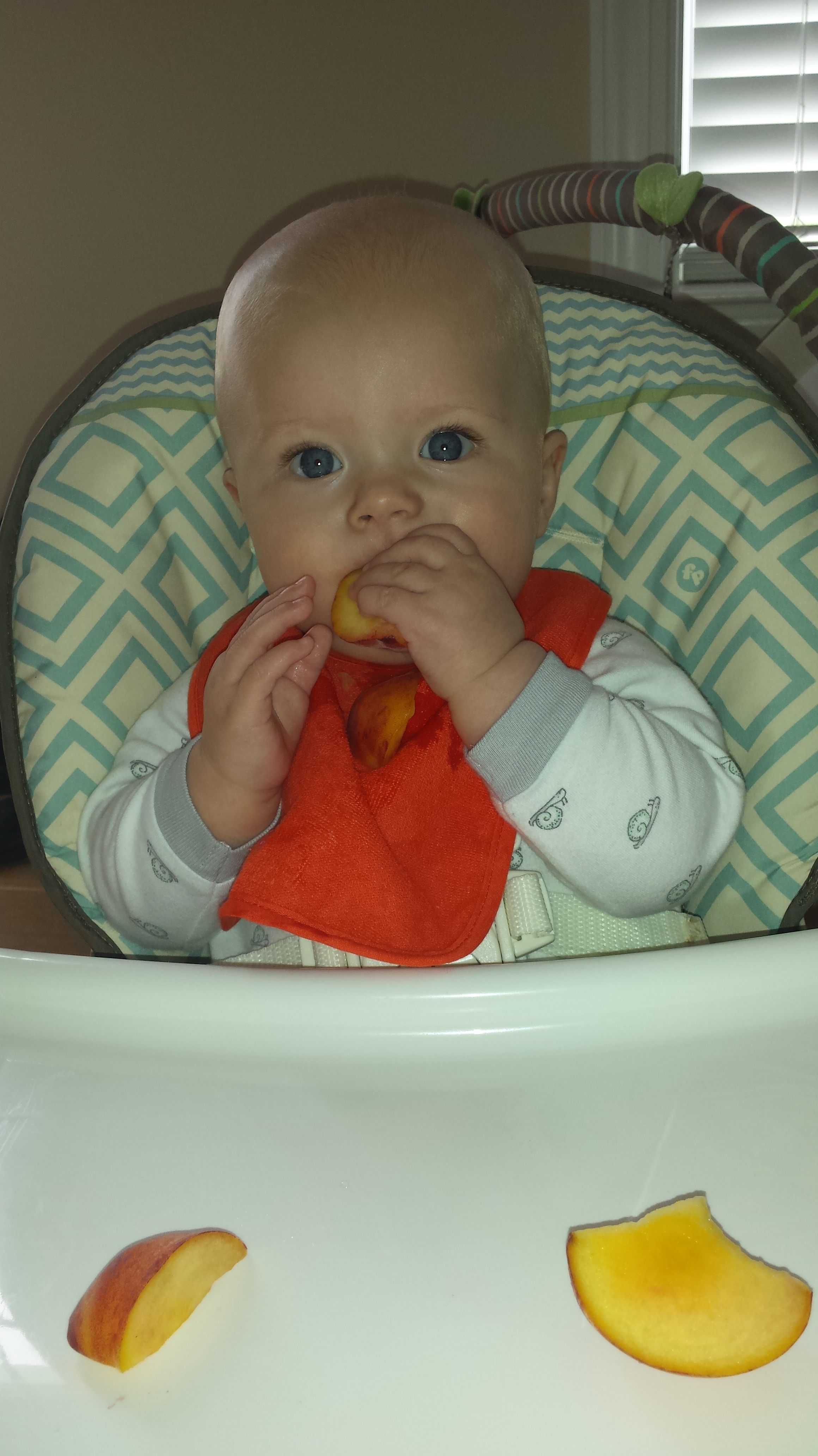
About a month after we started our BLW journey, I started getting concerned. It seemed like most people (from the books, blogs, websites) noticed their baby starting to actually eat food just a few weeks into BLW. Gerrit was definitely enjoying the food we offered. He tried everything with enthusiasm, but he wasn’t eating anything. Anytime something made its way to the back of his mouth, he gagged it back out. Which I realize I should address…
Gagging. It happens. And it is NOT choking. Choking is when you can’t get air because of a blockage. Gagging is the body’s defense mechanism against choking. In babies, the gag reflex is much further forward than in adults, so when you introduce solid foods, they will gag. Some will gag a lot. Gerrit gagged a lot! I was fully prepared for this, so when it happened, I remained calm and let Gerrit get the food back out on his own. The only help I would offer is to lean him forward a bit if he looked like he needed help. One thing not to do? Don’t stick your finger in your baby’s mouth to try to fish the food out for them. You’re much more likely to push it back further and actually cause them to choke. This is another reason I preferred to have Andrew around for the introduction of new foods. We both have had training in infant CPR, and I’d like to think that we both would remain calm and do what needs to be done if Gerrit choked. But I feel safer having 2 adults present. Just in case I freak out. And just in case one of us needs to call 911. You just never know. Call me a worrier (and I am), but this is my kid we’re talking about: I want to be ready for anything.
Back to our story! So Gerrit was not eating anything. And, as I mentioned above, I am a worrier by nature. I started worrying that he wasn’t getting all the nutrients he needed from my milk. I worried that he wasn’t getting the iron he needed. So I tried offering rice cereal mixed with some pureed fruit. Although I didn’t like the idea of rice cereal (pretty much no nutrients there), it was fortified with iron, so I decided to give it a try. Well, that didn’t last long. Gerrit made a face and spit it back at me every time. I also tried some other store-bought baby foods. Same thing: make a face and spit it out. So that was a waste. I have no idea if it’s because he was already used to solids and didn’t want to deal with mush or if he would have reacted that way if we had introduced the purees first.
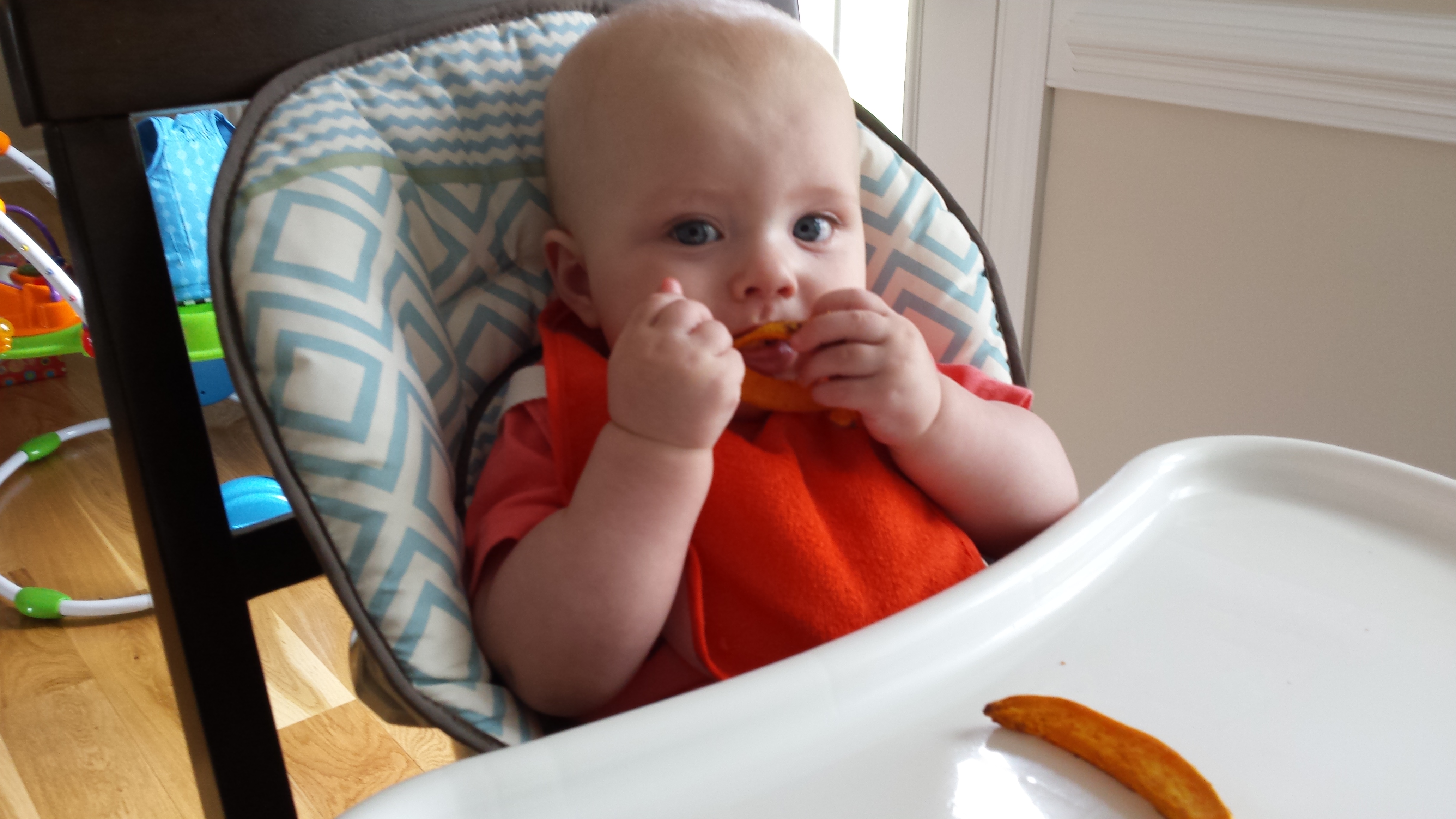
So we just continued. I kept offering new foods. Once in awhile I would see evidence that Gerrit had actually consumed something other than breast milk (yes, I inspected his poopy diapers…pretty sure it’s a mom thing). So that was always encouraging. Then I increased his meals to twice a day, thinking he might need more exposure. It really didn’t do much, but Gerrit always enjoyed the food. And that’s the funny thing. They say you shouldn’t offer solids when your child is crabby or tired, because they’re more likely to refuse it. But if Gerrit was crabby and we offered him food? He calmed right down and got to work looking it over, squishing it, and tasting it. While he wasn’t really eating much, he definitely was benefiting from BLW.
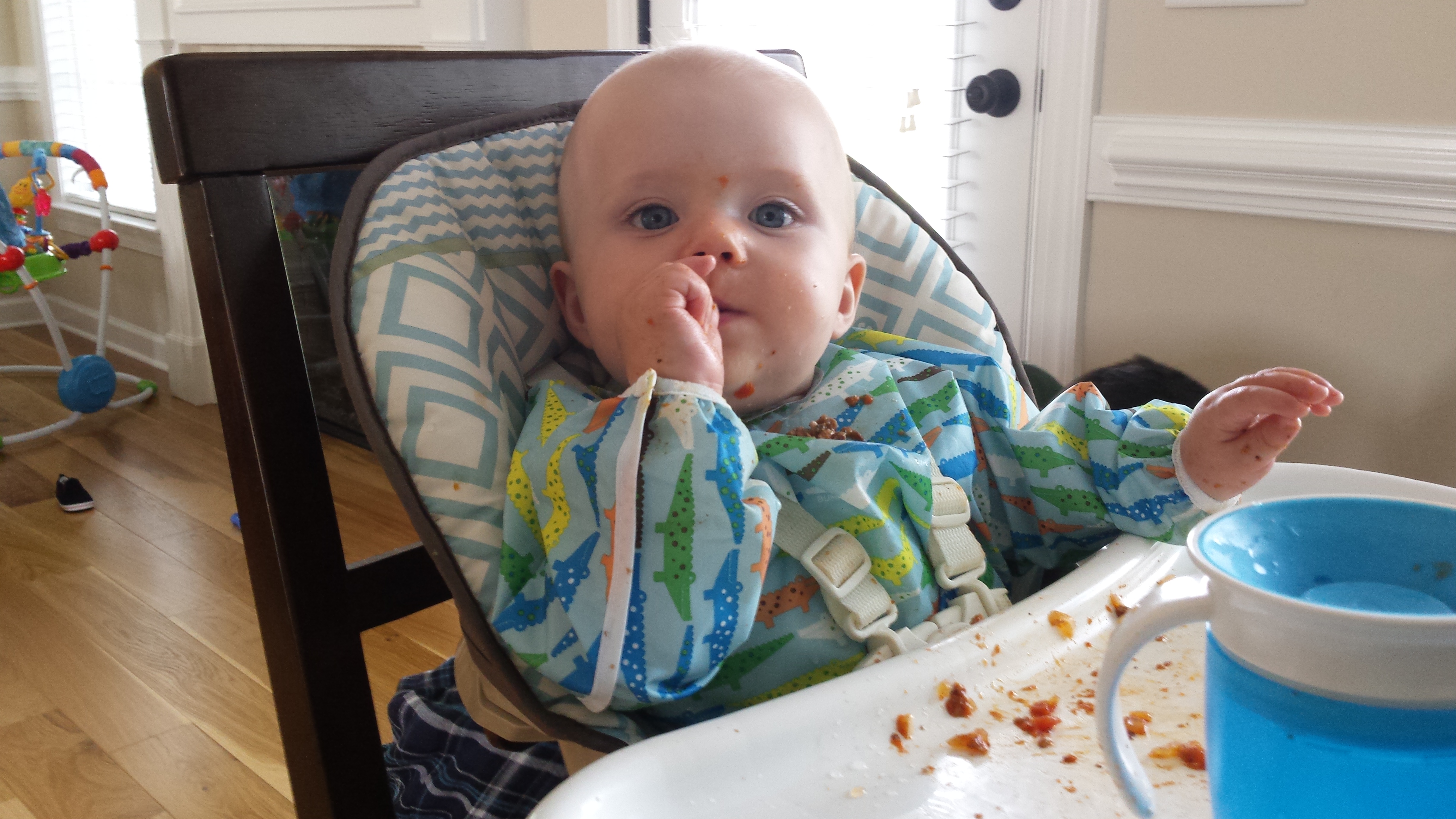
Like that smock bib? This goes on Gerrit whenever he’s eating something particularly messy or has long sleeves on. A big thanks to my friend Jenna for recommending them!
Almost exactly to the day, Gerrit started eating more when he turned 9 months old. By then, he had 2 teeth, so maybe that was helping. When we would clean up after a meal, we realized that we really weren’t cleaning up much! He obviously had eaten the majority of what we had offered. It was pretty exciting! I was also getting better at offering 3 meals a day and eating those meals with him. I had read that there are plenty of babies that are slow to take to solids… many don’t really start eating much until 9 or 10 months old… or later! And at Gerrit’s 9 month well baby appointment, his pediatrician was not at all concerned. She told us that a lot of the breastfed babies that she saw were slow to eat solids (pureed or with BLW). She wasn’t sure why that was, but she said Gerrit was healthy & happy and still gaining weight.
So there’s my take on baby-led weaning as well as lots of details about our progress with it so far. I hope I answered lot of questions and provided some good information for anyone who hasn’t heard about this way of beginning solids. Stay tuned for part 2 in a few months!
Oh and what to do with all that rice cereal?


 On An Even Kiel
So informative. 🙂 But I’m glad he’s catching on well and getting the hang of it. 🙂 Can’t believe he’s getting so big (literally :P)
LikeLike
I know, I go overboard with the information, don’t I? Lol… I can’t help myself!
LikeLike
Haha maybe a little. 🙂 but it’s okay!
LikeLike